
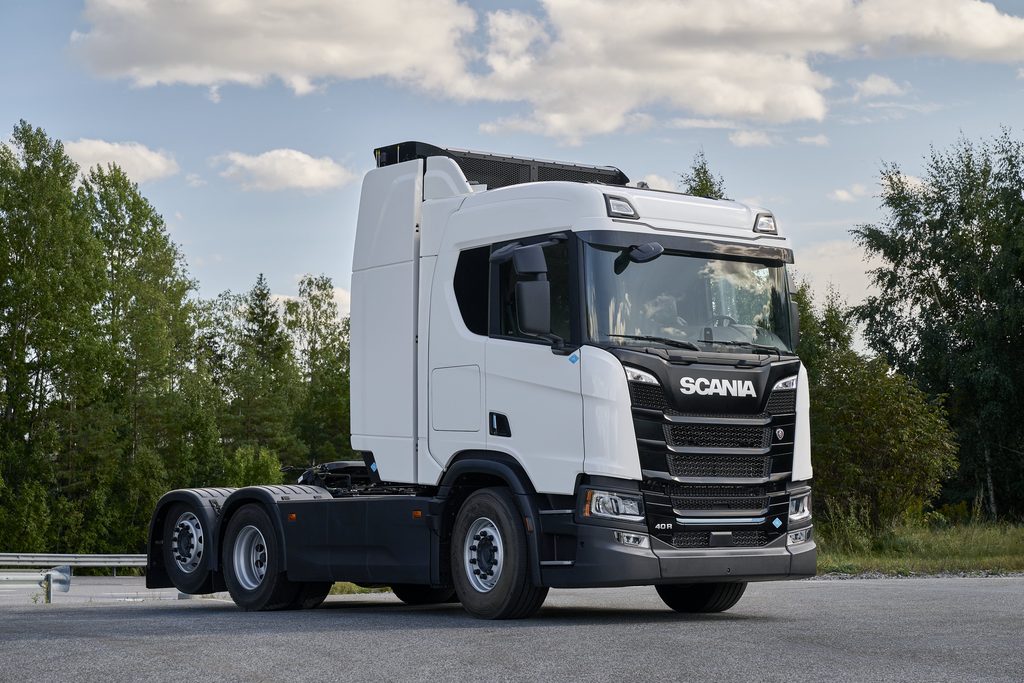
Transport company A. Peltola Oy will introduce Finland’s first high-capacity hydrogen fuel cell truck into commercial transport operations. Supplied by Scania, the truck is expected to begin operating between Jyväskylä and Helsinki around the turn of the year. Alongside the truck’s commercial operations, a heavy-duty hydrogen transport pilot coordinated by Cefmof will be launched to gather practical data and experience on the performance of a hydrogen truck in commercial logistics. The aim is to promote the wider adoption of hydrogen-powered heavy-duty transport in Finland.
Transport company A. Peltola Oy will add the hydrogen truck to its regular commercial fleet operating between Jyväskylä and Helsinki. In Finland, the truck will operate as part of a 68-tonne HCT (High-Capacity Transport) vehicle combination, making it the first fuel cell-powered HCT combination of this size in Europe. With the introduction of the new vehicle, A. Peltola Oy will gain experience with all four powertrain options used in heavy-duty transport: diesel, biogas, battery electric and hydrogen.
“We want to test new powertrain options in practice and find solutions that also work in real transport operations. The hydrogen truck will become part of our regular commercial operations, allowing us to gain valuable experience with the technology under real operating conditions. At the same time, we will gain experience with all four powertrain options used in heavy-duty transport,” says Ari Peltola, the owner of A. Peltola Oy.
Hydrogen fuel cell truck for long-haul transport
Scania will supply the hydrogen truck as part of its Pilot Partner programme. The vehicle is a fuel cell electric truck (FCEV), in which hydrogen is converted into electricity in a fuel cell to power the electric motor. The truck can also operate on battery power, as it has a large rechargeable battery that can be charged at charging stations.
The truck can carry 56 kilograms of hydrogen stored at a pressure of 700 bar. The combination of hydrogen and the rechargeable battery enables a driving range of several hundred kilometres.
“Through the Pilot Partner programme, we can test fuel cell technology together with our customers in real transport operations. Finland’s long distances and high combination weights make it a particularly interesting testing environment. Our cooperation with A. Peltola Oy will provide all parties with valuable information on how the technology performs in heavy-duty long-haul transport,” says Mika Jukkara, Product Manager at Scania Suomi Oy.
Aiming to expand hydrogen-powered heavy-duty transport
The introduction of the hydrogen truck is part of a heavy-duty hydrogen transport pilot launching in Jyväskylä. The pilot will gather practical data on the performance of the hydrogen truck as part of commercial logistics. The information will be used in the research and development of hydrogen-powered heavy-duty transport and to support its wider commercial adoption.
Cefmof coordinates and co-finances the pilot. The City of Jyväskylä’s participation in financing the pilot is also proceeding to the city’s decision-making process. The City Board is scheduled to consider carbon neutrality funding to be granted to Cefmof at its meeting on 21 September.
“For the first time in Finland, we will gain practical experience of operating a high-capacity hydrogen truck in real commercial logistics. The aim is to find out how the solution performs in practice under Finnish conditions, while gathering valuable information on the types of applications in which hydrogen-powered heavy-duty transport could be used in the future,” says Lauri Perämäki, Deputy Executive Director of Cefmof.
“Reducing emissions from heavy-duty transport requires new solutions and, above all, practical experience of how they perform in real-world use. In Jyväskylä, we have an opportunity to combine a central logistics location, hydrogen refuelling infrastructure, and the expertise of companies and research organisations,” says Ari Tolonen, Deputy Mayor of Business Development and Employment Services at the City of Jyväskylä.
Jyväskylä as a starting point for developing hydrogen-powered heavy-duty transport
In Jyväskylä, emissions from road transport have decreased significantly more slowly than emissions from other sources. Since 2007, the city’s total emissions have fallen by 57%, while emissions from road transport have decreased by 28%. If the current trend continues, road transport would be the city’s largest source of emissions in 2030.
Jyväskylä’s location along Finland’s major transport routes, its hydrogen refuelling infrastructure, and the region’s research and development activities provide favourable conditions for developing hydrogen-powered heavy-duty transport. The longer-term aim is to create the conditions for the development of a national hydrogen transport corridor, starting from Jyväskylä.
A. Peltola Oy’s hydrogen truck is expected to begin operations around the turn of 2026–2027. The vehicle combination will be used, for example, for food transport operations for Kesko and Valio. The truck will be refuelled at the hydrogen refuelling station in Jyväskylä operated by Cefmof Hydrogen Oy.
Scania hydrogen fuel cell truck briefly FCEV – fuel cell electric truck
- 56 kg of hydrogen, refuelling pressure 700 bar
- 300 kW fuel cell
- 416 kWh rechargeable propulsion battery
- 400 kW electric motor
- Gross combination weight of the HCT vehicle combination to be operated in Finland: 68 tonnes
- Commercial transport operations between Jyväskylä and Helsinki
Operations expected to begin around the turn of 2026–2027
